
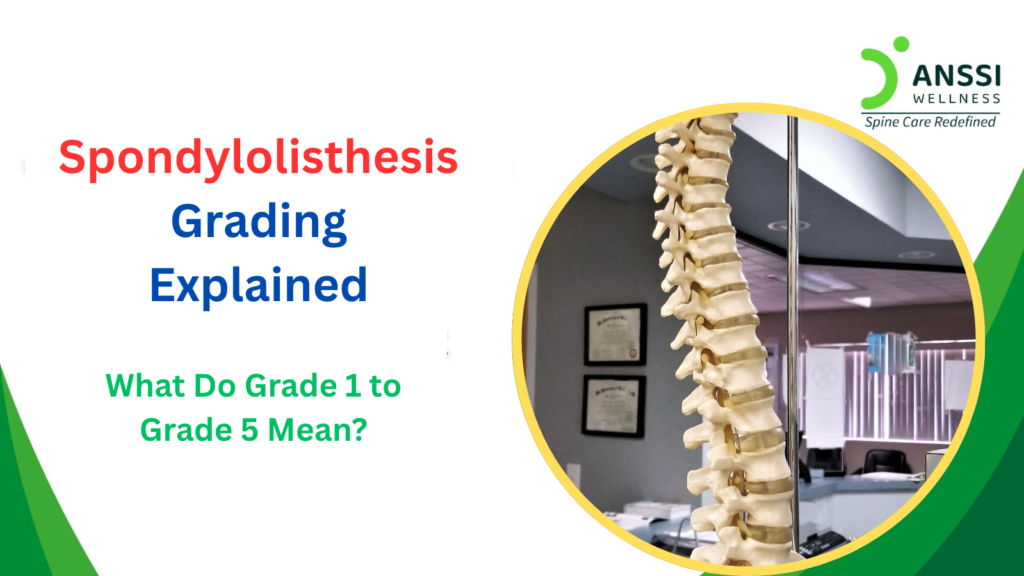
Spondylolisthesis is a spinal condition in which one vertebra slips forward over the vertebra below it. Unlike retrolisthesis, in which displacement is backward, spondylolisthesis involves anterior (forward) displacement that narrows the spinal canal, compresses nerve roots, and progressively destabilises the affected spinal segment.
The grade of spondylolisthesis, measured using the Meyerding classification system, is the single most important factor in determining treatment options, prognosis, and the urgency of intervention. Understanding what each grade means clinically is essential for every patient who has received this diagnosis.
What Causes Spondylolisthesis?
Spondylolisthesis arises from several distinct underlying mechanisms:
- Isthmic spondylolisthesis: A stress fracture of the pars interarticularis, the narrow bridge of bone connecting the upper and lower facet joints, allows the vertebral body to slip forward. This is the most common type in younger patients and athletes.
- Degenerative spondylolisthesis: Progressive degeneration of the facet joints and intervertebral disc reduces the structural restraints holding the vertebra in place, allowing anterior slip. This is the most common type in adults over 50 and is driven primarily by disc degeneration.
- Congenital spondylolisthesis: Developmental vertebral defects present from birth predispose to forward slip.
- Traumatic spondylolisthesis: Acute fracture causing immediate vertebral displacement.
- Pathological spondylolisthesis: Vertebral weakening from tumour, infection, or metabolic bone disease.
The lumbar spine is most commonly affected, L4-L5 in degenerative spondylolisthesis and L5-S1 in isthmic cases.
The Meyerding Grading System Explained
The Meyerding classification divides the superior surface of the lower vertebra into quarters and measures what percentage of the upper vertebra has slipped forward:
- Grade 1: Up to 25% forward displacement, mild slip; disc degeneration is typically the primary structural driver
- Grade 2: 25-50% displacement, moderate slip; increasing foraminal compromise and nerve root involvement
- Grade 3: 50-75% displacement, significant structural instability; progressive neurological risk
- Grade 4: 75-100% displacement, severe slip; high risk of neurological deficit and functional impairment
- Grade 5 (Spondyloptosis): Greater than 100% displacement, the vertebra has slipped completely off the vertebra below; surgical intervention is almost always required
Grade is an important guide, but it is not the only clinical determinant. Symptom severity, neurological status, patient age, activity level, and the rate of progression all influence treatment decisions alongside the Meyerding grade.
Clinical Presentation by Grade
Grade 1 Spondylolisthesis
Grade 1 is frequently asymptomatic or produces only mild, intermittent lower back pain and stiffness. There is nerve root irritation, as patients may experience mild radiating leg pain or tingling. This grade carries the best prognosis for non-surgical management; the slip is mild, disc height loss is typically partial, and structural correction through non-surgical intervention remains achievable.
Grade 2 Spondylolisthesis
Grade 2 produces more consistent lower back pain with radiating leg symptoms as foraminal narrowing deepens. A classic clinical sign at this grade is hamstring tightness; the hamstring muscles contract reflexively in response to nerve root irritation and the altered pelvic mechanics produced by the forward slip. Nerve root symptoms become more defined and persistent.
Grade 3 and Grade 4 Spondylolisthesis
These grades produce significant structural instability with chronic, severe lower back pain and progressive neurological deficits, leg weakness, altered gait, and, in advanced cases, bladder or bowel dysfunction. Visible postural changes may be apparent, such as a flattened lumbar lordosis and shortened trunk. Surgical evaluation is typically required at these grades.
Grade 5 Spondyloptosis
This represents complete vertebral displacement with profound neurological compromise. Surgical intervention is almost always necessary and urgent.
How Spondylolisthesis is Diagnosed
Accurate diagnosis and grading require a structured clinical and imaging assessment:
- Clinical examination: Involves postural assessment, gait analysis, neurological evaluation of the lower limbs, and hamstring tightness testing
- Weight-bearing X-ray: The primary modality for measuring forward slip percentage using the Meyerding classification; weight-bearing views are essential as slip may be underestimated on recumbent imaging
- MRI: Evaluates disc degeneration, nerve root compression, foraminal narrowing, and the soft tissue structures restraining the slip
- CT scan: Provides detailed assessment of the pars interarticularis defect in isthmic cases and the bony architecture in complex presentations
Why Early Diagnosis at Grade 1 is Critical
Grade 1 spondylolisthesis represents the widest treatment window. At this stage, disc degeneration, the primary driver of degenerative slip, is still partially reversible through targeted structural intervention. The slip percentage is mild, foraminal narrowing is limited, and nerve root compression has not yet produced permanent changes.
Without intervention, Grade 1 spondylolisthesis advances. Progressive disc degeneration deepens the segmental instability, the slip percentage increases, foraminal narrowing worsens, and nerve root compression intensifies. Each grade progression narrows the non-surgical treatment options and increases the likelihood that surgical stabilisation will eventually be required.
Non-Surgical Treatment Options for Grade 1 Spondylolisthesis
Non-Surgical Spinal Decompression Treatment (NSSDT)
For appropriately selected patients with Grade 1 degenerative spondylolisthesis driven by disc degeneration, NSSDT addresses the structural disc pathology that is the primary cause of forward slip.
Using a computer-controlled decompression table, NSSDT applies a precisely calibrated decompression force to the affected lumbar segment, generating negative intradiscal pressure within the degenerated disc.
NSSDT does not claim to fully reverse established vertebral displacement. Its clinical value in Grade 1 spondylolisthesis lies in addressing the disc degeneration driving the slip, slowing its progression, improving segmental stability, and relieving nerve root irritation without surgical intervention.
Treatment suitability is determined only after specialist evaluation including clinical examination and MRI review.
Physiotherapy and Spinal Stabilisation
- Strengthening the deep spinal stabilisers, the multifidus and transversus abdominis, reduces the segmental instability that allows anterior vertebral drift.
- Hamstring flexibility training addresses the characteristic hamstring tightness associated with spondylolisthesis and improves pelvic mechanics.
- Postural correction and movement retraining reduce the anterior shear forces acting on the affected segment during daily activities.
Lifestyle and Ergonomic Modification
Weight management reduces the compressive and shear loading placed on the affected lumbar segment.
Activity modification, particularly avoiding lumbar hyperextension movements that increase anterior shear, protects the slipped segment during recovery.
Ergonomic correction of sitting, standing, and lifting mechanics reduces the dynamic forces that perpetuate disc degeneration and segmental instability.
When Surgery May Be Necessary
Surgical consultation is warranted when:
- Grade 3 or Grade 4 displacement produces significant spinal instability and neurological compromise.
- Progressive neurological deficit, leg weakness, gait disturbance, bladder or bowel dysfunction, does not respond to conservative treatment.
- Grade 5 spondyloptosis is present, as complete displacement almost always requires surgical stabilisation.
- Persistent disabling symptoms remain despite an appropriately supervised course of conservative management.
About ANSSI:
ANSSI Wellness focuses on improving the quality of life for patients suffering from spinal issues, aiming to provide relief where other conventional treatments have failed. Through advanced Non-Surgical Spinal Decompression Treatment, ANSSI is committed to helping patients avoid surgery and recover in a safe, effective, and compassionate environment.
Book Consultation:
Call +91 9004726844 | 9920936844
Visit www.anssiwellness.com
Connect with ANSSI Wellness on LinkedIn, Instagram, and Facebook for expert guidance.